

Event E-12
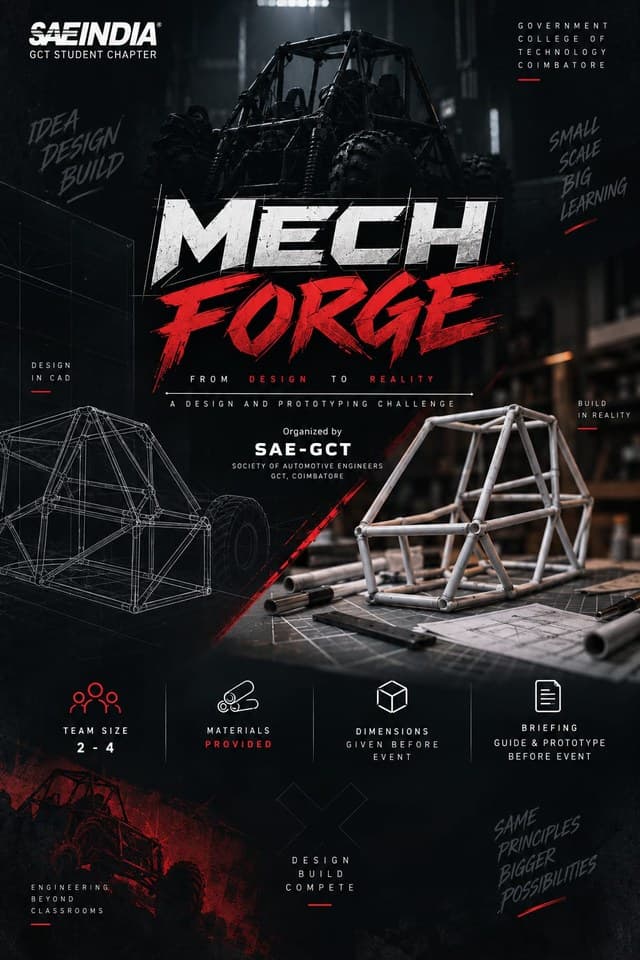
Mech Forge
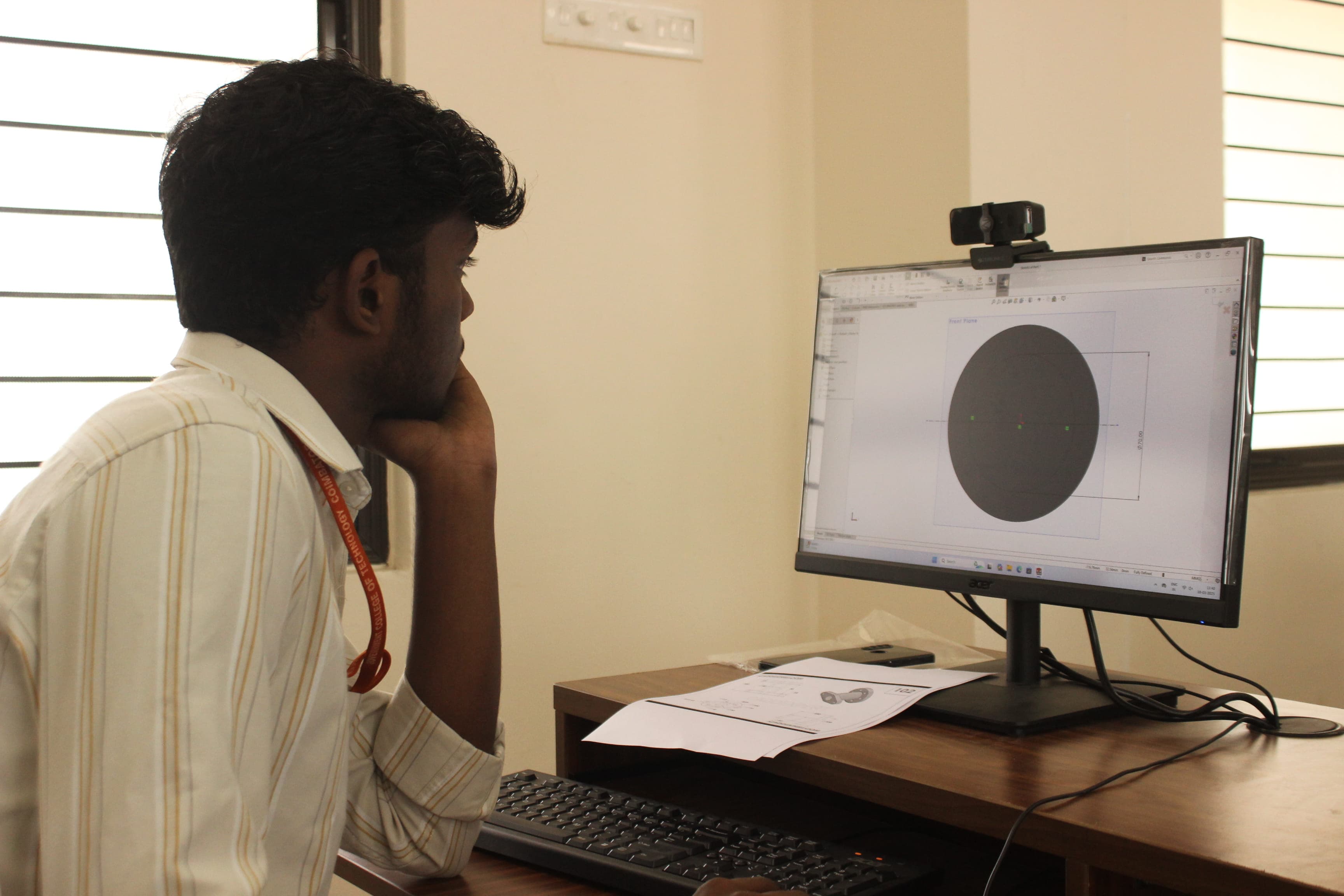
Design a BAJA-style vehicle rollcage in CAD, then build an accurate scaled physical prototype from basic materials.
- Time
- 9:00 am to 5:00 pm
- Duration
- 8 h
- Venue
- Government College of Technology, Coimbatore
- Team size
- 2 to 4
- Entry fee
- ₹150
- Prize pool
- --
- Seats left
- Open
Rules
- 1Organized by SAE-GCT (Society of Automotive Engineers, Government College of Technology, Coimbatore).
- 2An entry-level engineering design and prototyping challenge derived from traditional BAJA SAE competitions, bridging digital modeling with hands-on physical execution.
- 3Focus areas: design a vehicle rollcage in CAD, then physically translate that digital model into an accurate, scaled physical prototype using basic materials.
- 4Team size: 2 to 4 members.
- 5All stationery required for the event will be provided by the competition committee.
- 6Specific dimensions and detailed rollcage data are discussed prior to the competition.
- 7The complete guide and prototype will be shown and explained right before the event.
- 8All participating teams must strictly comply with technical inspection guidelines, bounding box limits, and scale specifications set out in the official rulebook.
- 9Teams are expected to maintain professional behaviour, uphold academic and engineering integrity, and display good sportsmanship toward competitors and event officials at all times.
- 10The rulings and point deductions handed down by technical inspectors and judges regarding structural integrity, craftsmanship, and dimensional compliance are final.
- 11Any attempt to falsify measurements, illegally alter prototypes post-inspection, or compromise the safety and fairness of the evaluation process results in immediate disqualification.
- 12Judging: design innovation & accuracy 30% (adherence to true SAE structural geometry, proper triangular load distribution, clean execution of complex compound angles); weight-to-strength efficiency / impact testing 30% (optimization of paper-tube wall thickness and structural hierarchy to maximize load-bearing capacity under minimal dead weight); manufacturing quality & aesthetics 20% (precision in cutting, joint fit-up, symmetry, accurate labelling of structural members); justification of the model 20% (ability to defend member selection, load paths, and scale calculations during technical review).